

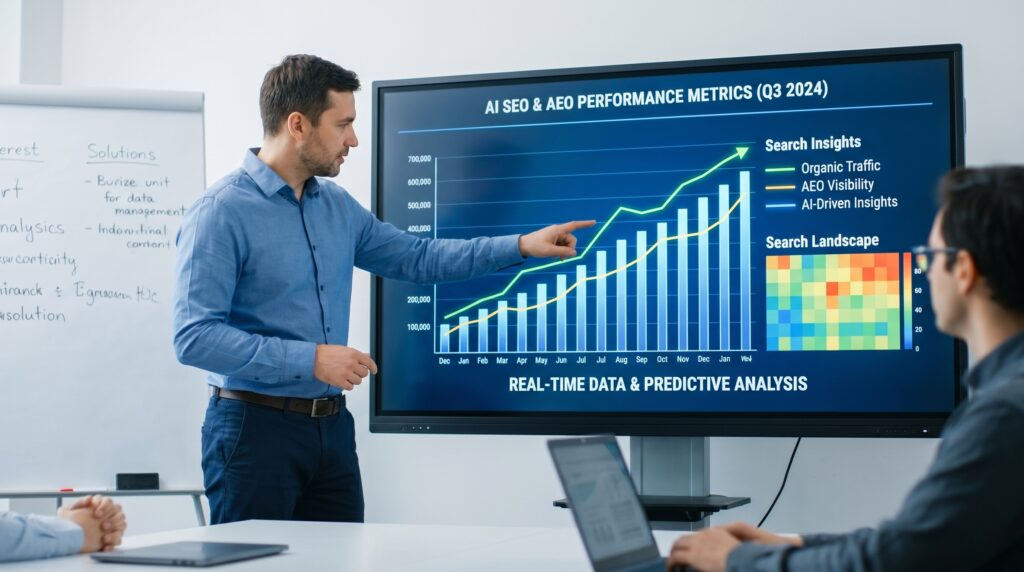
Search has fundamentally changed. The user who once typed three keywords into Google and scrolled through ten blue links is now asking ChatGPT for a recommendation, reading a Google AI Overview before ever clicking a result, or querying Perplexity for a cited, conversational answer. For businesses operating in the USA, this shift is not a future concern. It is the present reality.
At Ladhar Enterprise, we have been closely tracking this evolution and helping businesses adapt their digital strategies accordingly.
This guide breaks down everything you need to know about AI SEO and Answer Engine Optimization (AEO) in 2026 so your brand stays visible, authoritative, and competitive in a search landscape that now runs on artificial intelligence.
An estimated 2.5+ billion AI-assisted search queries are processed daily across all platforms, and 40 to 60 percent of US informational searches now trigger Google AI Overviews. (AI Rank Lab, 2026)
Traditional SEO was built on a clear premise: rank high on a search engine results page and earn clicks. That model still has value, but it is no longer the whole picture. AI SEO refers to the practice of optimising your content, technical infrastructure, and authority signals so that AI-powered systems such as Google’s AI Overviews, ChatGPT, Perplexity, Gemini, and Claude can understand, trust, and surface your brand.
The difference is significant. Where traditional SEO asks “Can Google index and rank this page?”, AI SEO asks “Will an AI system cite, summarise, or recommend this content when a user asks a relevant question?” These are meaningfully different objectives, and they require a meaningfully different approach.
At Ladhar Enterprise, we work with US businesses across sectors to close the gap between where they currently rank and where AI systems will actually recommend them. The window for early-mover advantage remains open, but it is narrowing quickly.
Answer Engine Optimisation, or AEO, is the discipline of structuring your content so that AI answer engines, voice assistants, and conversational search tools can extract, trust, and present your information as the definitive response to a user query.
You have seen AEO in action every time a Google featured snippet appears at the top of a results page. In 2026, that concept has expanded dramatically. AI Overviews, voice search responses, and LLM-generated summaries now draw from the same pool of structured, authoritative content. If your content is not built to be extracted by these systems, it simply will not be cited.
AEO services typically focus on three core areas:
According to research presented at ACM KDD 2024 by Princeton University, content optimised for generative engines achieves up to 40 percent higher visibility in AI-generated responses compared to pages relying solely on conventional SEO signals. AEO is not theoretical. It delivers measurable results.
We do not treat AEO as an add-on. Every content strategy we build at Ladhar Enterprise integrates structured data, entity clarity, and conversational keyword targeting from the ground up.
Understanding where AI SEO fits requires understanding how dramatically the search landscape has shifted in a short period of time. Here is what we are observing across the US market in 2026:
1. Google AI Overviews Are Now Mainstream
Google’s AI Overview feature now appears in 40 to 60 percent of US informational searches. Users are increasingly receiving synthesised, AI-generated answers before they ever consider clicking an organic result. For brands, this means that being cited within an AI Overview can deliver brand attribution at scale, even when the user does not visit your site directly.
2. ChatGPT and LLMs Are Genuine Discovery Channels
ChatGPT’s search feature processes enormous query volumes, and research from Semrush in April 2026 shows that 88 percent of URLs cited by ChatGPT are drawn directly from search results. Critically, brands are 6.5 times more likely to be cited through third-party sources than through their own domains alone, which underscores the importance of building a broader digital authority footprint.
3. Zero-Click Search Is Accelerating
As AI summarises more queries directly on the results page, traditional click-through rates are shifting. Pages appearing in AI Overviews currently see a 15 to 30 percent reduction in organic CTR for the same queries. However, those same pages earn brand recognition and recommendation authority that traditional ranking cannot provide in the same way.
4. E-E-A-T Has Never Been More Critical
Google’s E-E-A-T framework, which stands for Experience, Expertise, Authoritativeness, and Trustworthiness, remains the single most important editorial standard for AI-friendly content. AI systems do not recommend content they cannot verify as credible. Human-reviewed, expert-backed content consistently outperforms purely automated output in AI citation rates.
At Ladhar Enterprise, we have distilled our AI SEO approach into five interconnected components that together determine how well a brand performs across both traditional and AI-powered search environments.
Technical SEO Foundation
AI systems cannot bypass poor infrastructure. Your website must be crawlable, indexable, fast-loading, mobile-optimised, and free from critical errors. Core Web Vitals, internal linking architecture, and proper canonical implementation are all prerequisites before any AEO work will yield results.
Semantic Content Strategy
Generative AI engines no longer simply match keywords. They interpret intent and context. Your content needs to be semantically rich, meaning it covers a topic comprehensively with clear headings, concise summaries, and natural language that mirrors how users actually phrase questions. Long-form, structured content that targets AI comprehension consistently outperforms thin, keyword-dense pages in AI visibility.
Schema Markup and Structured Data
Implementing Organisation, FAQPage, HowTo, and Article schema provides the explicit data signals that LLMs look for when generating summaries. If you are not using structured data, you are making it harder for AI to read your site accurately, and harder for it to surface your brand in answer-format responses.
Authority and Citation Building
Because AI systems are 6.5 times more likely to cite brands through third-party sources, building your presence across reputable external platforms is essential. This means earning genuine editorial coverage, accumulating quality backlinks, maintaining updated profiles on authoritative directories, and creating content that thought leaders and journalists can reference.
Conversational Keyword Targeting
Users interacting with AI search tools tend to ask full questions rather than fragment keywords. Your content strategy must map to these conversational, long-tail queries. Targeting phrases like “best AI SEO strategy for US businesses in 2026” rather than simply “AI SEO” aligns your content with how AI systems interpret and respond to real user intent.
We combine deep technical SEO expertise with forward-looking AI content strategy. Our team monitors performance across Google AI Overviews, ChatGPT, Perplexity, and Gemini to ensure our clients are building visibility where search is actually going, not just where it has been.
A question we frequently hear from US businesses is whether they should shift budget from traditional SEO to AEO. The answer, based on the data we analyse at Ladhar Enterprise, is that the most effective strategy integrates both.
SEO remains the foundation. Your pages still need to rank, be crawled, and be trusted. AEO ensures that the same authority and relevance carry over into the answer layer, where AI systems decide which sources to summarise and recommend. According to a 2026 Content Marketing Institute survey, 42 percent of B2B content marketers are already reallocating budget from traditional SEO content toward AEO-optimised content. The trend is clear, but the transition should be strategic, not abrupt.
The brands winning in 2026 are those building a unified system where technical SEO, content design, structured data, authority signals, and user experience all reinforce each other. They are not chasing individual channels in isolation.
If you are evaluating agencies or services for AI SEO and AEO, there are several critical questions worth asking before committing to a partnership.
At Ladhar Enterprise, we provide transparent reporting that separates traditional organic performance from AI visibility metrics, so you always know exactly where your brand stands in both environments.
The AEO software market alone is estimated at between 1.2 and 2.0 billion dollars in 2026, growing at 45 to 60 percent annually. Between 35 and 45 percent of Fortune 1000 companies now have dedicated AEO programmes or include AEO in their agency briefs. The gap between enterprise adoption and small-to-mid-size business adoption represents a significant opportunity for US businesses willing to invest early.
Looking forward, we expect AI systems to place increasing weight on real-time content freshness, multi-platform brand authority, and verified expertise signals. Brands that build these foundations now will compound their advantage as AI search continues to mature.
We are also tracking the rise of Generative Engine Optimisation (GEO) as a closely related discipline, which focuses specifically on earning visibility within AI-generated summaries on platforms like Perplexity and Google AI Mode. This is an area we actively integrate into client strategies at Ladhar Enterprise.
Ladhar Enterprise helps US businesses build AI-ready digital strategies that perform in Google AI Overviews, ChatGPT, Perplexity, and beyond. Visit us at ladharenterprise.com to start a conversation about your 2026 search strategy.
Traditional SEO focuses on ranking web pages in search engine results pages. AI SEO expands this to include optimising for AI-powered answer engines, such as Google AI Overviews, ChatGPT, and Perplexity, which synthesise and recommend content rather than simply listing links. Both disciplines are needed in 2026.
AEO stands for Answer Engine Optimisation. It involves structuring content so that AI systems can accurately extract, trust, and present it as a direct answer to user queries. It matters because an increasing share of US searches now result in AI-generated answers rather than traditional click-through results.
Results vary based on your current technical foundation, content depth, and domain authority. In our experience at Ladhar Enterprise, initial improvements in AI visibility typically begin to appear within three to five months of implementing structured data, E-E-A-T-aligned content, and authority-building initiatives.
Absolutely. Technical SEO remains the infrastructure layer on which everything else is built. AI systems cannot bypass poor site health, slow load times, or thin content. Traditional SEO ensures your site is crawlable, indexable, and authoritative. AEO then ensures that authority extends into AI-generated search experiences.
The primary platforms to focus on for US audiences in 2026 are Google AI Overviews, ChatGPT, Perplexity, and Gemini. Each platform has slightly different retrieval behaviours, which is why a comprehensive, multi-platform visibility strategy such as the one we build at Ladhar Enterprise is the most effective long-term approach.
We do not treat AEO as a bolt-on addition to traditional SEO. We integrate structured data, conversational content architecture, entity-level authority building, and multi-platform citation monitoring into every strategy we build. Our reporting separates AI visibility from traditional ranking metrics so clients always have a clear and accurate picture of their performance.
AI Digital Marketing Agency