
How AI Search Engines Crawl, Index & Rank Content

image

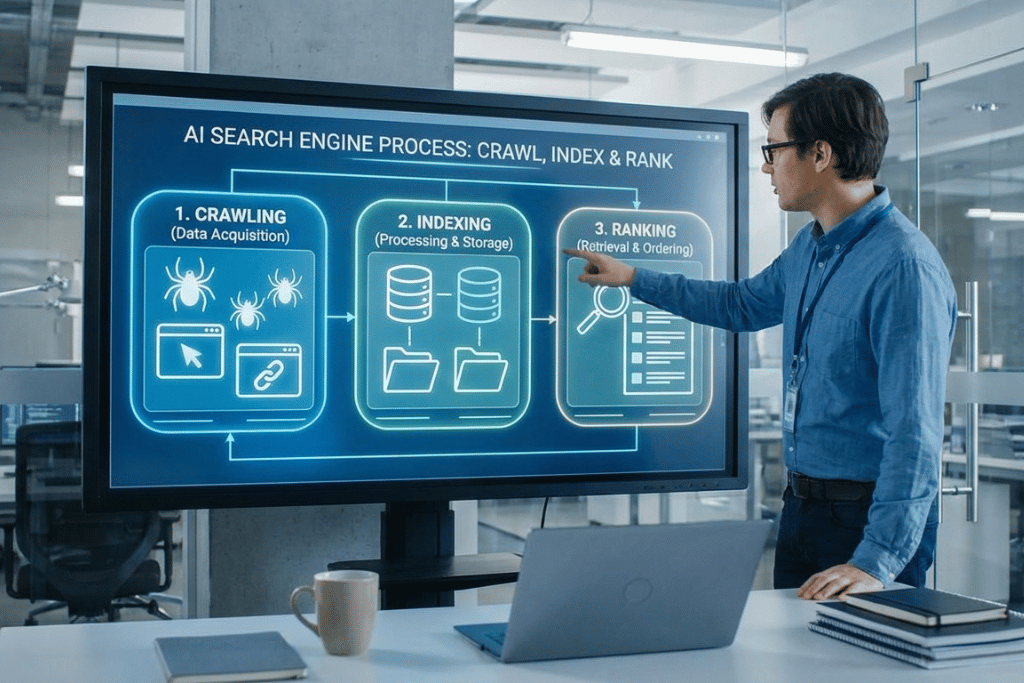
AI search engines now behave more like research assistants than simple link finders, but they still rely on the same three pillars: crawling, indexing, and ranking. AI has changed how each stage works, what “quality” means, and which brands get surfaced or cited.

From Classic to AI Search Engines

Traditional search engines like Google still dominate click‑driven traffic, but AI layers now sit on top of them and siphon attention through direct answers and summaries. At the same time, AI crawlers such as GPTBot and other LLM bots have massively increased non‑human traffic to websites.

Key 2025–2026 shifts you need to know:

  • Crawler traffic grew 18% from May 2024 to May 2025, with GPTBot alone surging by 305%, showing how aggressively AI models now collect web content.
  • Google still drives nearly 90% of traditional search referrals, but AI Overviews and AI modes now appear on more than 50% of search results across devices.
  • AI engines like ChatGPT, Perplexity, and Bing Copilot heavily rely on citations, with ChatGPT averaging about 10.4 links and Google AI Overviews about 9.3 links per response.​

For brands, this means you are simultaneously optimizing for:

  • Classic SERPs (blue links).
  • AI Overviews/answer boxes on Google.
  • Stand‑alone AI search engines (Perplexity, Bing Copilot, ChatGPT’s search modes).

Ladhar Enterprise US builds strategies that treat these channels as one integrated AI visibility ecosystem instead of siloed SEO campaigns, which is crucial when AI is reusing your content across multiple engines.

How Crawling Works in the AI Era

Crawling is the discovery and re‑discovery of your pages by bots that request URLs, parse content, and push it into an index. Modern systems combine classic crawlers (Googlebot, Bingbot) with AI crawlers that feed generative models.

Modern crawling characteristics

  • Scalable crawlers fetch massive quantities of pages every day, adjusting crawl rate based on site quality, change frequency, and server response.​
  • Googlebot remains the dominant web crawler, and Google’s AI‑focused crawlers collected roughly three times more webpage data than competitors in 2025.
  • Crawl cadence varies: news and product pages can be revisited within minutes or hours, while evergreen content might be revisited every few days.​

AI‑search‑ready crawling also cares about:

  • Robots.txt and meta directives to know what’s allowed for search vs training.
  • Structured semantics (clean HTML, headings, schema) so LLMs can parse entities and relationships, not just text blobs.​

Where Ladhar Enterprise US helps:

  • Crawl‑budget audits to consolidate thin pages, fix redirect chains, and reduce wasted bot hits on low‑value URLs.
  • Technical fixes (sitemaps, robots, canonical tags) that ensure both search and AI bots reach your highest‑value content first.
  • Change‑frequency strategies (e.g., updating key commercial pages monthly) to encourage more frequent recrawls and fresher AI summaries.

Indexing: From Keywords to Vectors

Indexing used to mainly mean creating an inverted index that maps words to documents. AI search adds a second layer: vector indexes that represent meaning, not just exact terms.​

Modern indexes typically include:

  • Inverted index for fast keyword lookups across hundreds of billions of documents.​
  • Vector space index for semantic retrieval using embeddings and neural networks.​
  • Canonicalization logic to resolve redirect chains and avoid duplicated entries across domains.​

Key technical trends for 2025–2026:

  • Sparse (BM25‑like) retrieval is still used to assemble candidate results, while dense retrieval with two‑tower encoders and cross‑encoders reranks the top results based on semantic similarity.​
  • Indices are sharded by region and content type and use compression and vector quantization to scale globally.​
  • Near‑real‑time indexing paths can surface new or updated pages within minutes or hours, especially for high‑priority or news‑like content.​

For AI search engines:

  • LLMs rely on these underlying indexes plus additional ranking signals (E‑E‑A‑T, source diversity, citation history) before generating an answer.
  • Tools like Perplexity and ChatGPT show a concentration on a smaller, highly trusted set of domains; the top 3 domains in Perplexity responses, for example, account for over 17% of all sources cited.​

Ladhar Enterprise US builds AI‑ready information architectures—clear URL taxonomies, internal linking, and schema markup—to strengthen both inverted and vector index performance, increasing your chance of being selected as a cited authority.

Ranking Signals in AI Search Engines

Ranking now blends deterministic ranking signals with behavioral and AI‑specific factors. At a high level, systems still look at relevance, quality, and user experience—but how they measure each has evolved.

Core ranking factors

Traditional and AI‑augmented engines consider:

  • Content relevance and intent match: Queries are mapped to intents using query tokens, click history, and dwell time, then matched to URLs that best satisfy that intent.​
  • Authority and E‑E‑A‑T: Domain credibility, expertise, and trustworthy citations are heavily weighted in AI Overviews and AI search engines.
  • Freshness: Recent updates and publication dates influence whether a page is chosen for AI responses, especially on fast‑moving topics.​
  • UX and performance: Time‑to‑first‑byte and time‑to‑render are monitored, with goals around 200–300 ms response times on edge clusters for common queries.​

AI‑specific ranking and citation behavior

In AI Overviews and AI search:

  • AI Overviews appear in at least 30% of U.S. desktop queries and over 50% when all devices and query types are included, making AI ranking a mainstream visibility factor.
  • Most AI Overviews still link to at least one domain in the top 10 organic results—92.36% of AI Overview responses linked to a domain that ranked in the top 10—but the overlap is falling slightly, meaning lower‑ranked pages sometimes get picked for citations.​
  • ChatGPT, Perplexity, Google AI Overviews, and Bing Copilot differ in the number of sources they cite and in how concentrated those sources are, with ChatGPT citing the most and Bing the fewest.​

This creates a dual objective:

  • Rank well in classic SERPs to be in the candidate pool.
  • Structure and enrich content so AI models prefer your site when assembling synthesized answers.

Ladhar Enterprise US uses this understanding to design content that ticks both boxes: strong traditional rankings and high citability in AI outputs, especially for U.S. audiences comparing products, services, or solutions.

Practical Optimization Tactics for 2026

To win in AI‑driven search, your content needs to be easy to crawl, clear to index, and compelling to rank and cite. A few data‑backed priorities emerge from current research.

Structure for intent and answers

  • Use clear H1–H3 hierarchies, FAQs, and summary boxes to signal answer‑ready content.
  • Align each page with a specific search intent (informational, commercial, transactional) and support it with relevant CTAs and internal links.​
  • Provide concise, fact‑rich paragraphs that AI systems can quote directly, supported by high‑quality external citations.

Strengthen authority and freshness

  • Invest in topical clusters and first‑party research; AI search engines and Overviews favor original data and in‑depth coverage.
  • Refresh high‑value pages regularly—research shows that updating older content can sharply increase organic traffic, and frequent updates also boost AI inclusion probability.
  • Build diversified authority: PR, digital mentions, and high‑quality backlinks still feed into PageRank‑like authority signals that AI systems use.

Optimize for AI search behavior

  • Target question‑style long‑tail queries and comparisons, which often trigger AI Overviews and AI search sessions.
  • Provide multimedia (images, video transcripts, alt text) to enrich meaning and accessibility, which are considered content quality signals.​
  • Track AI visibility (e.g., whether your brand is being cited in Overviews or AI engines) alongside classic keyword rankings.

Ladhar Enterprise US can roll this into a practical roadmap: technical clean‑up, AI‑ready on‑page templates, and content refresh cadences tailored to U.S. search behavior in your niche.

Why Partner with Ladhar Enterprise US Now

AI search is moving from an experiment to the default interface for many queries, and brands that adapt early are capturing outsized visibility and revenue.

Here’s how Ladhar Enterprise US can support you:

  • AI‑first technical audits: Diagnose crawl issues, index gaps, and performance bottlenecks that limit your presence in both traditional SERPs and AI Overviews, then prioritize fixes that improve crawl efficiency and recency signals.
  • AI‑optimized content frameworks: Build scalable templates that combine intent‑focused headings, answer blocks, FAQs, and schema, designed to rank in Google and be cited in AI engines like Perplexity, Bing Copilot, and ChatGPT.
  • GEO and AI visibility programs: Integrate Generative Engine Optimization (GEO) with classic SEO so you’re not just chasing positions but securing brand mentions inside AI‑generated answers across platforms.
  • Analytics for AI search: Set up dashboards that track organic rankings, AI Overview presence, and citations across AI tools, ensuring you can measure ROI as AI’s share of search continues to rise.

If you want your content to be discovered, understood, and recommended by the new generation of AI search engines, you need strategies that span crawling, indexing, and ranking—not just keywords.

Ladhar Enterprise US specializes in exactly this AI‑first search reality for 2026. Reach out to their team to audit your current visibility, redesign your content architecture, and build an AI‑ready search strategy that compounds over the next 12–24 months.

FAQs: Frequently Asked Questions

How is AI search different from traditional search?

AI search engines focus on giving direct answers instead of just a list of links, often summarizing content and citing a handful of sources. Traditional search still relies primarily on ranked SERP listings and click‑through to websites. 

AI Overviews and chat‑style engines combine classic ranking signals with LLMs to synthesize information, which means brands must optimize for both visibility and citability.

The basic steps—crawling, indexing, and ranking—are still there, but AI adds semantic and vector‑based layers on top of classic keyword indexes. 

Search and AI bots now account for roughly a quarter of all web requests, and AI bots are second only to traditional search bots in crawling volume. 

Modern AI search engines maintain both inverted and vector indexes so they can retrieve content by meaning, not just exact phrases.

AI search engines and AI Overviews still depend on relevance, authority, and user experience, but they add new weight to E‑E‑A‑T, freshness, and clear citation‑ready structures like Q&As and data points. 

Studies show that around 76% of AI Overview citations are pulled from pages already in Google’s top 10 organic results, but overlap isn’t perfect, meaning well‑structured lower‑ranked pages can still be chosen as sources.

AI search traffic has surged—one major analysis reports AI search traffic growing over 500% year‑on‑year, and AI Overviews now reach around 2 billion monthly users. 

At the same time, up to 55–60% of searches can result in no clicks when AI answers satisfy the query on the results page. This makes it crucial to appear both in classic results and within AI‑generated summaries to protect and grow organic visibility.

Yes—brands should keep writing for humans but structure content for AI engines with clear sections, headings, FAQs, and schema to make extraction easier. 

Data‑backed, well‑sourced content and topic clusters improve your chances of being selected and cited by AI search systems across Google, Perplexity, and Bing Copilot. 

Many SEO teams now report better performance when they combine human expertise with AI tools for research, content outlining, and on‑page optimization.